 Patient Portal
VivAer® Nasal Obstruction Treatment
What is nasal obstruction?
Many people with nasal obstruction experience difficulty breathing through their nose, habitual snoring, interrupted sleep and fatigue.
Nasal obstruction is often caused by anatomical blockage in the nose, hindering airflow. As a result, you may feel congested or “stuffy”. Home remedies and medications may offer temporary relief. It’s only when your nasal airway is opened that you can expect to find real, lasting relief.
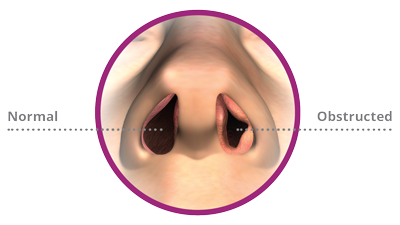 Common symptoms of nasal obstruction:
- Trouble breathing through your nose
- Nasal congestion
- Difficulty sleeping
- Difficulty breathing during physical exertion
VivAer®Treatment
Lasting relief is possible.
If you regularly experience difficulty breathing through your nose and nothing seems to help, you may have nasal obstruction. Until now, finding a long-term solution often meant surgery. Now, your physician may be able to offer you lasting relief by performing a non-invasive VivAer treatment to open your nasal airway.
Lasting Relief. 97% of patients experienced significant improvement in nasal breathing.¹
Non-invasive solution. Minimal discomfort, no incisions, and can be performed in our office.
Live better. Clinically shown to significantly improve quality of life and provide long-lasting relief.¹
Breathe better. Live better.
The VivAer treatment is clinically shown to provide high satisfaction and lasting relief.¹ Patients typically return to normal daily activity the same day.*
- 97% of patients experienced significant improvement in nasal breathing¹
- 94% of patients improved their ability to get enough air through their nose during exercise or exertion2
- 89% of patients reported getting a better night’s sleep2
Am I a candidate for the VivAer® treatment
To find out, take these two simple tests.
Cottle’s Maneuver
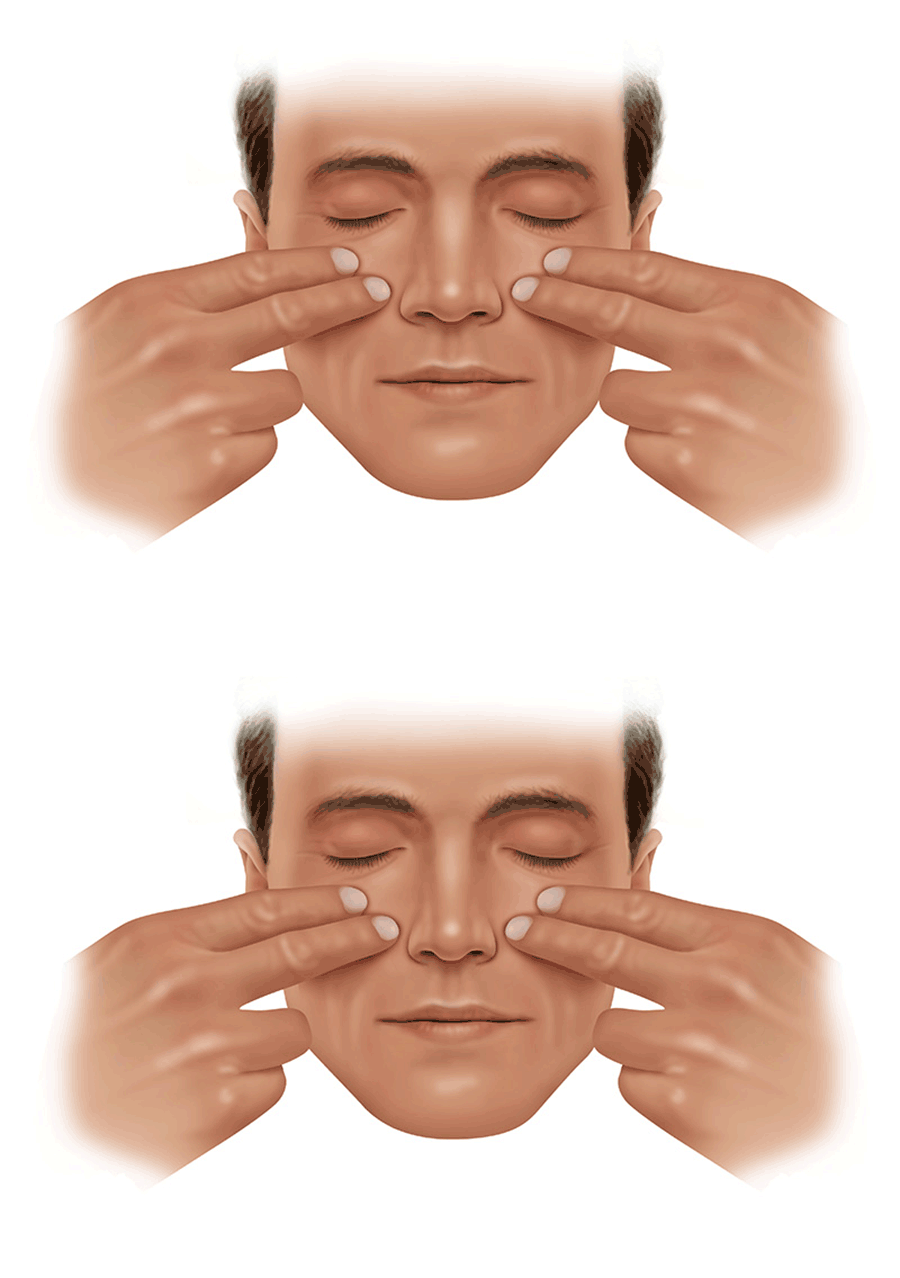 Step 1. Place two fingertips on your cheeks, on each side of your nose.
Step 2. Gently press and pull outward to further open your nasal passage. While holding, breathe through your nose.
Did the Cottle’s maneuver help you breathe better? If so, you may be a candidate.
NOSE Score
Complete the questionnaire below.
Schedule an appointment today!
View Important Safety Information.
*Individual results may vary.¹
Ephrat M, Jacobowitz O, Driver M. Quality-of-life impact after in-office treatment of nasal valve obstruction with a radiofrequency device: 2-year results from a multicenter prospective clinical trial. Int Forum Allergy Rhinol. 2020;00:1-11
https://doi.org/10.1002/alr.22667
Prospective, Multi-Center, Non-Randomized Study to Evaluate the Quality of Life Impact After Treatment of Nasal Airway Obstruction Using the Aerin Medical VivAer Stylus. Aerin Medical Report TR680-01.
RhinAer® Chronic Rhinitis Treatment
What is chronic rhinitis?
Chronic rhinitis is persistent inflammation of the tissues lining the nose, resulting in symptoms such as a constant runny nose and often post-nasal drip, congestion, coughing, nasal itching, and sneezing. While symptoms may be related to allergies, symptoms from chronic rhinitis may occur all year.
This challenging condition can negatively impact your life in countless ways. And trying to find an effective treatment can be frustrating. Like many, you may manage your symptoms using medications and sprays. Unfortunately, these treatments only provide temporary relief. It’s only when the root cause of your rhinitis is addressed that you can expect to find real, lasting relief.
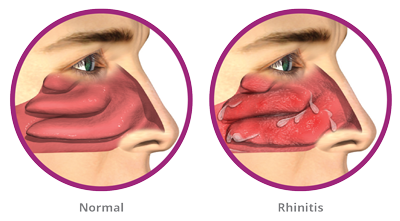 Symptoms of chronic rhinitis include:
- Persistently runny nose
- Post-nasal drip
- Nasal congestion
- Itching and sneezing
RhinAer®Treatment
Lasting relief is possible.
If any or all of the symptoms listed above sound familiar, you may be one of the millions of people living with chronic rhinitis. Until now, treatment often meant managing symptoms with medications and sprays. For many patients, these symptoms may be caused by abnormal signals in the nose. Now, your physician can offer you RhinAer to disrupt these signals and provide lasting relief. In a clinical study, patients treated with RhinAer experienced significant relief from chronic rhinitis symptoms.1 Patients typically return to normal activity on the same day.*
Lasting Relief. Provides lasting relief of symptoms including runny nose, post-nasal drip, and chronic cough.¹
Non-invasive solution. Minimal discomfort, no incisions, and can be performed in our office.
Live better. In a clinical study, patients reported significant improvements in their symptoms and quality of life.¹
Am I a candidate for the RhinAer® treatment
To find out, complete the Total Nasal Symptom Score questionnaire below.
Schedule an appointment today!
View Important Safety Information.
*Individual results may vary.
¹ Clinical Evaluation of Low Power Radiofrequency Energy Applied to the Posterior Nasal Nerve Area for Symptomatic Relief of Chronic Rhinitis (RhinAer Stylus). Aerin Medical Report TR898.
Balloon Sinuplasty Video
Thyroid and Parathyroid Disease
Your thyroid gland is one of the endocrine glands that makes hormones to regulate physiological functions in your body, like metabolism (heart rate, sweating, energy consumed). Other endocrine glands include the pituitary, adrenal and parathyroid glands and specialized cells within the pancreas.
The thyroid gland is located in the middle of the lower neck, below the larynx (voice box) and wraps around the front half of the trachea (windpipe). It is shaped like a bow tie, just above the collarbones, having two halves (lobes) joined by a small tissue bar (isthmus.). You can’t always feel a normal thyroid gland.
What is a thyroid disorder?
Diseases of the thyroid gland are very common, affecting millions of Americans. The most common thyroid problems are:
- An overactive gland, called hyperthyroidism (e.g., Graves’ disease, toxic adenoma or toxic nodular goiter)
- An underactive gland, called hypothyroidism (e.g., Hashimoto’s thyroiditis)
- Thyroid enlargement due to overactivity (as in Graves’ disease) or from under-activity (as in hypothyroidism). An enlarged thyroid gland is often called a “goiter”.
Patients with a family history of thyroid cancer or who had radiation therapy to the head or neck as children for acne, adenoids or other reasons are more prone to develop thyroid malignancy.
If you develop significant swelling in your neck or difficulty breathing or swallowing, you should call your surgeon or be seen in the emergency room.
What treatment may be recommended?
Depending on the nature of your condition, treatment may include the following:
Hypothyroidism treatment:
- Thyroid hormone replacement pills
Hyperthyroidism treatment:
- Medication to block the effects of excessive production of thyroid hormone
- Radioactive iodine to destroy the thyroid gland
- Surgical removal of the thyroid gland
Goiters (lumps):
If you experience this condition, your doctor will propose a treatment plan based on the examination and your test results. He or she may recommend:
- An imaging study to determine the size, location and characteristics of any nodules within the gland. Types of imaging studies include CT or CAT scans, ultrasound or MRIs.
- A fine-needle aspiration biopsy – a safe, relatively painless procedure. With this procedure, a hypodermic needle is passed into the lump, and tissue fluid samples containing cells are taken. Several passes with the needle may be required. Sometimes ultrasound is used to guide the needle into the nodule. There is little pain afterward and very few complications from the procedure. This test gives the doctor more information on the nature of the lump in your thyroid gland and may help to differentiate a benign from a malignant or cancerous thyroid mass.
Thyroid surgery may be required when:
- the fine needle aspiration is reported as indeterminate, suspicious or suggestive of cancer
- imaging shows that nodules have worrisome characteristics or that nodules are getting bigger
- the trachea (windpipe) or esophagus are compressed because one or both lobes are very large
Historically, some thyroid nodules, including some that are malignant, have shown a reduction in size with the administration of thyroid hormone. However, this treatment, known as medical suppression therapy, has proven to be an unreliable treatment method.
What is thyroid surgery?
Thyroid surgery is an operation to remove part or all of the thyroid gland. It is performed in the hospital, and general anesthesia is usually required. Typically, the operation removes the lobe of the thyroid gland containing the lump and possibly the isthmus. A frozen section (immediate microscopic reading) may be used to determine if the rest of the thyroid gland should be removed during the same surgery.
Sometimes, based on the result of the frozen section, the surgeon may decide not to remove any additional thyroid tissue, or proceed to remove the entire thyroid gland, and/or other tissue in the neck. This decision is usually made in the operating room by the surgeon, based on findings at the time of surgery. Your surgeon will discuss these options with you pre-operatively.
As an alternative, your surgeon may choose to remove only one lobe and await the final pathology report before deciding if the remaining lobe needs to be removed. There also may be times when the definite microscopic answer cannot be determined until several days after surgery. If a malignancy is identified in this way, your surgeon may recommend that the remaining lobe of the thyroid be removed at a second procedure. If you have specific questions about thyroid surgery, ask your otolaryngologist to answer them in detail.
What happens after thyroid surgery?
During the first 24 hours:
After surgery, you may have a drain (tiny piece of plastic tubing), which prevents fluid and blood from building up in the wound. This is removed after the fluid accumulation has stabilized, usually within 24 hours after surgery. Most patients are discharged later the same day or the next day. Complications are rare but may include:
- Bleeding
- Bleeding under the skin that rarely can cause shortness of breath, requiring immediate medical evaluation
- A hoarse voice
- Difficulty swallowing
- Numbness of the skin on the neck
- Vocal cord paralysis
- Low blood calcium
At home:
Following the procedure, if it is determined that you need to take any medication your surgeon will discuss this with you prior to your discharge. Medications may include:
- Thyroid hormone replacement
- Calcium and/or vitamin D replacement
Some symptoms may not become evident for two or three days after surgery. If you experience any of the following, call your surgeon or seek medical attention:
- Numbness and tingling around the lips and hands
- Increasing pain
- Fever
- Swelling
- Wound discharge
- Shortness of breath
If a malignancy is identified, thyroid replacement medication may be withheld for several weeks. This allows a radioactive scan to better detect any remaining microscopic thyroid tissue, or spread of malignant cells to lymph nodes or other sites in the body.
How is a diagnosis made?
The diagnosis of a thyroid function abnormality or a thyroid mass is made by taking a medical history and a physical examination. In addition, blood tests and imaging studies or fine-needle aspiration may be required. As part of the exam, your doctor will examine your neck and ask you to lift up your chin to make your thyroid gland more prominent. You may be asked to swallow during the examination, which helps to feel the thyroid and any mass in it. Tests your doctor may order include:
- Evaluation of the larynx/vocal cords with a mirror or a fiberoptic telescope
- An ultrasound examination of your neck and thyroid
- Blood tests of thyroid function
- A radioactive thyroid scan
- A fine-needle aspiration biopsy
- A chest X-ray
- A CT or MRI scan
Balloon Sinuplasty
The Facts about Chronic Sinusitis:
|
Balloon Sinuplasty Video |
|
|
|
|
|
How Does Balloon Sinuplasty Work?
|
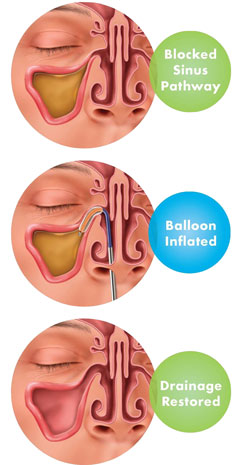
Sinuses are air-filled pockets behind the facial bones surrounding the nose. Each sinus has an opening through which mucus drains. This drainage keeps your sinuses working well and you healthy. Anything that obstructs that flow may cause a buildup of mucus in the sinuses, which may lead to infection and inflammation of the sinuses.
Sinusitis occurs when the linings of your nose, sinuses and throat become inflamed, possibly from a pre-existing cold or allergies. Chronic sinusitis is when this inflammation lasts three months or more.
Why choose Balloon Sinuplasty?
Balloon Sinuplasty is a minimally invasive procedure that opens sinus passages. It relieves the pain and pressure associated with chronic sinusitis.
Safe - More than 150,000 patients have been treated safely with Balloon Sinuplasty Technology.
Proven - 95% of patients who have had the procedure say they would have it again.
Fast - While recovery time varies with each patient, many people were more able to perform day to day activies at home and work.
A typical procedure lasts less than 45 minutes. Depending on your insurance coverage, the in-office procedure may reduce the procedure costs you pay.
Is Balloon Sinuplasty Right for You?
Symptoms
If you’ve has any of the following 3 symptoms for 10 days or more:
- Facial pressure or pain
- Headache pain
- Congestion or stuffy nose
- Thick, yellow-green nasal discharge
- Low fever (99˚ - 100˚F)
- Bad breath
- Pain in the upper teeth
Duration and Frequency
- If you’ve experienced these symptoms for 12 or more weeks.
- If you’ve experienced these symptoms for 10 days or longer on 3 separate occasions with interim periods of no symptoms